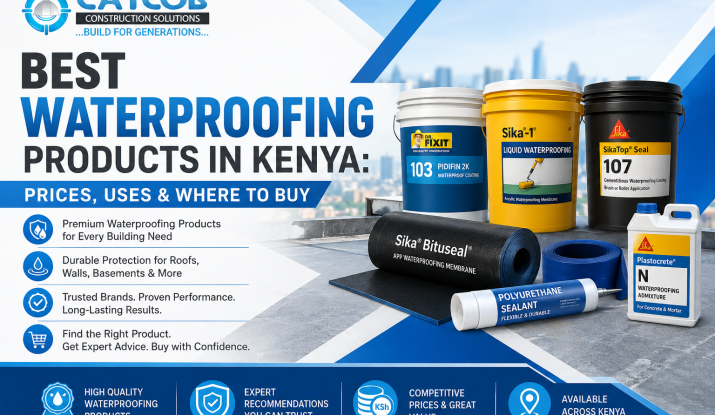
Water damage can cause some of the most expensive and difficult-to-repair problems in residential, commercial and industrial buildings. From leaking flat roofs and damp walls to basement seepage, concrete cracks and leaking water tanks, choosing the right waterproofing product in Kenya is essential for long-term protection.
But there is no single waterproofing product that is best for every project.
The right material depends on the surface being protected, the source of the water, whether the structure is above or below ground, the expected movement of the substrate, exposure to sunlight and weather, drainage conditions and the method of application.
For this reason, property owners, developers, contractors and engineers should consider the type of waterproofing system rather than simply choosing the cheapest waterproofing material available.
At Catcob Construction Solutions, waterproofing systems are selected according to the requirements of the project. Catcob’s solutions include liquid-applied waterproofing, APP bituminous membranes, concrete waterproofing systems, waterproof membranes, water bars, sealants and other construction products.
This guide explains the best waterproofing products and materials in Kenya, what they are used for, approximate costs, where they are suitable and how to choose the right waterproofing solution for your building.
What Are Waterproofing Products?
Waterproofing products are construction materials designed to reduce or prevent the movement of water through roofs, concrete, walls, foundations, basements, terraces, joints and other building components.
Depending on the application, waterproofing may be achieved using:
- Liquid waterproofing membranes
- Cementitious waterproofing coatings
- APP bituminous membranes
- Waterproofing admixtures
- Waterproofing sealants
- PVC waterstops
- Bituminous coatings
- Acrylic waterproofing coatings
- Polyurethane waterproofing systems
- Crack repair materials
- Joint sealants
- Integral concrete waterproofing systems
Some products are applied to the surface of an existing structure, while others are incorporated into concrete or installed within construction joints during construction.
The most suitable solution depends on the specific water-intrusion problem.
Best Waterproofing Products in Kenya
The following are some of the major waterproofing product categories used for construction and waterproofing projects in Kenya.
1. APP Bituminous Waterproofing Membranes
APP bituminous membranes are among the most widely used membrane waterproofing systems for roofs, concrete slabs and other applications where a durable waterproof barrier is required.
APP stands for Atactic Polypropylene, a polymer used to modify bitumen and improve the performance characteristics of the membrane.
APP membranes are supplied in rolls and are commonly installed using heat to bond the membrane to the prepared substrate.
Catcob offers APP bituminous membrane application using membranes from established manufacturers, including Sika and other brands. The company notes that different membrane thicknesses are available for different environmental and project requirements.
Common uses of APP membranes
APP membranes can be used for:
- Flat concrete roofs
- Roof slabs
- Terraces
- Commercial buildings
- Industrial buildings
- Basement structures
- Foundations
- Podiums
- Concrete decks
- Low-slope roofing systems
Advantages of APP membranes
- Strong waterproofing barrier
- Suitable for exposed and protected applications depending on the system
- Good resistance to temperature variations
- Suitable for low-slope roofs
- Available in different thicknesses
- Can provide long-term protection when correctly installed
When should you choose an APP membrane?
APP membrane waterproofing can be particularly suitable when a project requires a robust membrane system for a concrete roof or other suitable substrate.
However, correct surface preparation, detailing, overlaps, drainage and installation are critical.
Related Catcob service:
APP Bituminous Membranes Application
2. Liquid Waterproofing Membranes
Liquid waterproofing is another popular waterproofing solution in Kenya, particularly for surfaces where a seamless waterproofing layer is required.
Unlike sheet membranes, liquid waterproofing is applied as a liquid coating that cures to form a continuous waterproof layer.
Catcob provides liquid waterproofing solutions for applications including roofs, terraces and bathrooms. Its website highlights seamless application, weather resistance and suitability for irregular surfaces as key advantages.
Common applications
Liquid waterproofing can be used for:
- Flat roofs
- Roof terraces
- Concrete slabs
- Balconies
- Bathrooms
- Wet areas
- Concrete surfaces
- Selected commercial applications
Benefits of liquid waterproofing
A properly specified liquid waterproofing system can:
- Form a seamless waterproof layer
- Cover irregular surfaces
- Reduce the number of joints
- Simplify detailing around penetrations
- Provide protection against rainwater
- Be suitable for maintenance and refurbishment projects
Is liquid waterproofing better than an APP membrane?
Not necessarily.
The better option depends on the substrate, roof design, movement, exposure, drainage, existing waterproofing and required lifespan.
For example, a liquid system may be advantageous where a seamless coating is required, while an APP membrane may be preferable where a robust sheet membrane system is specified.
Read more:
Liquid Waterproofing in Kenya
3. Cementitious Waterproofing Products
Cementitious waterproofing products are cement-based waterproofing materials that can be applied to concrete and masonry surfaces.
They are particularly useful in areas where a cement-compatible waterproof coating is required.
Common applications
Cementitious waterproofing can be used for:
- Basements
- Foundations
- Concrete walls
- Water-retaining structures
- Bathrooms
- Wet areas
- Concrete slabs
- Selected underground structures
Catcob’s FAQ identifies cementitious waterproofing coatings among the solutions used for waterproofing and notes their application in areas such as flat roofs and wet environments depending on the project requirements.
Benefits
- Compatible with many concrete surfaces
- Useful for below-ground applications
- Can be applied to concrete and masonry
- Suitable for many wet-area applications
- Can be incorporated into broader waterproofing systems
However, cementitious products should be selected according to the substrate and exposure conditions. They are not automatically the best solution for every roof or structure.
4. Waterproofing Concrete Admixtures
Waterproofing admixtures are added to concrete during mixing rather than applied only to the finished surface.
They can help reduce water permeability and improve the durability of concrete when properly specified and incorporated into an appropriate concrete mix.
Catcob lists concrete admixtures among its waterproofing solutions.
Where are waterproofing admixtures used?
They can be considered for:
- Foundations
- Basement walls
- Concrete slabs
- Water-retaining structures
- Underground structures
- Concrete tanks
- Swimming pools
- Other structures where reducing concrete permeability is important
Why use waterproofing admixtures?
The advantage is that waterproofing protection becomes part of the concrete system rather than relying solely on a surface coating.
However, admixtures should not be viewed as a substitute for proper structural detailing, crack control, drainage and joint treatment.
5. Waterproofing Sealants
Waterproofing sealants are used to seal joints, cracks, gaps, penetrations and interfaces where water could enter a structure.
They are particularly important because even a good waterproofing membrane can fail if joints and penetrations are poorly detailed.
Catcob’s FAQ identifies polyurethane, silicone, acrylic and polysulphide sealants as options for different exterior sealing applications. It also mentions products used for joints, cracks and anchoring applications.
Waterproofing sealants can be used for:
- Construction joints
- Expansion joints
- Roof penetrations
- Cracks
- Wall-to-floor joints
- Concrete interfaces
- External joints
- Seams and connections
Why are sealants important?
Water often enters buildings through weak points rather than through the middle of an intact waterproof membrane.
Proper joint and crack treatment is therefore an important part of a complete waterproofing system.
6. PVC Waterstops
PVC waterstops are designed to control water movement through concrete construction joints.
They are commonly installed when concrete structures are being constructed and are especially important for structures exposed to water pressure.
Typical applications include:
- Basements
- Water tanks
- Swimming pools
- Foundations
- Retaining structures
- Underground structures
- Construction joints
- Expansion joints
Catcob lists water bars among its waterproofing products.
A waterstop should be correctly positioned and securely installed before concrete placement.
7. Waterproofing Coatings
Waterproofing coatings form a protective layer over a substrate.
Depending on the formulation, coatings may be based on acrylic, cementitious, polyurethane, epoxy or other technologies.
Catcob’s FAQ specifically identifies acrylic waterproof coatings, nano-technology-based waterproofing, epoxy coatings and silicone-based sealants among exterior waterproofing options.
Waterproofing coatings may be suitable for:
- Concrete roofs
- External walls
- Terraces
- Wet areas
- Concrete structures
- Selected refurbishment projects
The correct coating should be selected based on exposure, movement, UV exposure, substrate condition and the type of water intrusion involved.
8. Crack Repair and Waterproofing Products
Cracks can provide direct pathways for water into concrete structures.
Simply applying a waterproof coating over an active or significant crack may not solve the underlying problem.
Depending on the nature of the crack, repair systems may include:
- Crack fillers
- Epoxy repair products
- Injection systems
- Flexible sealants
- Structural repair materials
Catcob’s FAQ mentions Sikadur 31CF and epoxy injection systems for certain concrete crack repair applications.
Before choosing a crack repair product, it is important to establish whether the crack is:
- Structural
- Non-structural
- Active
- Static
- Shrinkage-related
- Caused by movement
- Associated with water pressure
Which Waterproofing Product Is Best for a Flat Roof in Kenya?
Flat roofs require careful waterproofing because water can remain on the surface if drainage and falls are inadequate.
Catcob identifies APP bituminous membranes, liquid waterproofing membranes, polyurethane liquid membranes and cementitious systems among possible approaches for flat roofs, depending on the project.
Common options include:
| Waterproofing product | Suitable application |
|---|---|
| APP membrane | Concrete flat roofs and low-slope roofs |
| Liquid membrane | Roofs, terraces and irregular surfaces |
| Polyurethane membrane | Selected roofs and concrete surfaces |
| Cementitious coating | Selected concrete and wet-area applications |
| Waterproofing admixture | New concrete construction |
| Sealants | Joints, cracks and penetrations |
The correct solution should be determined after inspecting the roof.
Catcob service:
Flat Roof & Concrete Gutters Waterproofing
Best Waterproofing Products for Basements in Kenya
Basements experience different waterproofing challenges from roofs.
Water may reach a basement through:
- Foundation cracks
- Construction joints
- Hydrostatic pressure
- Poor drainage
- Defective waterproofing
- Groundwater
- Wall-floor junctions
For this reason, basement waterproofing normally requires a system rather than one product.
Potential components include:
- Waterproofing membranes
- Cementitious coatings
- Waterproofing admixtures
- PVC waterstops
- Joint sealants
- Crack repair systems
- Drainage solutions
Catcob’s basement waterproofing process begins with an assessment to identify sources of water intrusion before developing a customized waterproofing plan.
Read more:
Basement Waterproofing
Best Waterproofing Products for Concrete in Kenya
Concrete is not completely waterproof simply because it is strong.
Water can penetrate concrete through pores, cracks, construction joints and poorly detailed interfaces.
For concrete structures, waterproofing may involve:
- Integral waterproofing admixtures
- Surface coatings
- Cementitious waterproofing
- Membrane systems
- Joint sealants
- Waterstops
- Crack repair systems
Catcob’s concrete waterproofing solutions include integral waterproofing, coating systems and Sika products.
The appropriate combination depends on whether the concrete is new or existing and whether the water pressure is positive or negative.
Best Waterproofing Products for Water Tanks
Water tanks require careful product selection because the waterproofing system must be compatible with the tank’s intended use.
Underground tanks can develop leakage through:
- Concrete cracks
- Construction joints
- Pipe penetrations
- Poorly treated corners
- Defective coatings
Catcob’s FAQ identifies specialist below-ground products for leaking underground tanks, including water plugs and waterproofing coatings.
For an existing leaking tank, the first step should be identifying the exact source of the leak before selecting the repair product.
Best Waterproofing Products for Bathrooms
Bathrooms are continuously exposed to water and require proper waterproofing before finishes such as tiles are installed.
Suitable waterproofing systems may include:
- Cementitious waterproofing
- Liquid waterproofing membranes
- Joint sealants
- Crack treatment systems
- Waterproofing coatings
Catcob’s FAQ specifically mentions waterproofing coatings such as Sika Seal 105 and DR.FIX IT 113 for bathroom leakage applications.
Proper attention should also be given to:
- Floor-to-wall junctions
- Shower areas
- Pipe penetrations
- Floor drains
- Corners
- Construction joints
Waterproofing Products Prices in Kenya
One of the most common questions from property owners is:
How much do waterproofing products cost in Kenya?
There is no single price for waterproofing products because different products vary significantly in formulation, packaging, coverage, thickness and application requirements.
The total cost also depends on whether you are purchasing the material only or paying for a complete waterproofing system that includes preparation and professional installation.
Catcob’s published Nairobi service pricing provides the following indicative figures:
- Liquid waterproofing: from approximately KSh 5,000 per m²
- Concrete waterproofing: approximately KSh 8,000–KSh 12,000 per m²
- Membrane waterproofing: approximately KSh 10,000–KSh 15,000 per m²
These are waterproofing service/application figures, not universal retail prices for individual products. Actual project costs can vary depending on surface area, material specification, surface condition and project complexity.
For a more accurate figure, the project should be assessed before materials and application costs are confirmed.
Related guide:
Waterproofing Solutions in Nairobi Prices
What Determines the Price of Waterproofing Products?
Several factors influence the final price of waterproofing materials and systems.
1. Product Type
An APP membrane, liquid membrane, cementitious coating and waterproofing admixture have different costs and application requirements.
2. Coverage
A product covering 5 m² per container will have a different effective cost per square metre from one covering 15 m².
3. Required Thickness
Some systems require multiple coats or a specified membrane thickness.
4. Surface Preparation
Existing concrete may require:
- Cleaning
- Grinding
- Crack repair
- Priming
- Removal of failed coatings
- Screeding
- Levelling
5. Labour
Professional application can represent a significant portion of the total waterproofing project cost.
6. Accessibility
A roof, basement or underground tank may require different equipment, preparation and safety procedures.
7. Condition of the Structure
A new structure and an existing leaking structure will normally require different approaches.
Where to Buy Waterproofing Products in Kenya
When buying waterproofing materials, do not choose a supplier based on price alone.
Look for a supplier that can help you identify:
- The correct product
- Correct coverage
- Required thickness
- Compatible primer
- Surface preparation requirements
- Application method
- Suitable accessories
- Manufacturer specifications
Catcob Construction Solutions positions itself as an authorized applicator and primary distributor of waterproofing products in Kenya, offering products and application expertise for different waterproofing requirements.
Catcob’s product range includes waterproof membranes, APP bituminous membranes, concrete admixtures and water bars, alongside other construction products.
For buyers in Nairobi and elsewhere in Kenya, professional guidance can be particularly valuable when the product will be installed on a roof, basement, tank or other critical structure.
Sika Waterproofing Products in Kenya
Sika is one of the brands associated with Catcob’s waterproofing solutions.
Catcob’s website identifies Sika products across several applications, including liquid membranes, concrete admixtures and sealants.
The important consideration, however, is not simply choosing a recognized brand.
The product still needs to be suitable for:
- The substrate
- Water pressure
- Exposure
- Movement
- Temperature
- Required thickness
- Intended service life
- Application conditions
Read more:
Sika Waterproofing Products Nairobi
How to Choose the Best Waterproofing Product in Kenya
Before purchasing a waterproofing product, answer these questions.
1. Where is the water coming from?
Is it rainwater, groundwater, plumbing leakage, condensation or water pressure?
2. What surface needs waterproofing?
Is it:
- Concrete
- Masonry
- Metal
- Roof slab
- Foundation
- Basement wall
- Water tank
- Bathroom
- Terrace
3. Is the structure new or existing?
New construction allows waterproofing measures to be incorporated into the structure.
Existing buildings may require repair, preparation and remedial waterproofing.
4. Is the surface exposed to UV?
Some waterproofing systems require additional protection when exposed to sunlight.
5. Is there structural movement?
A rigid product may not be suitable where significant movement is expected.
6. Is there hydrostatic pressure?
Basements and underground structures can experience water pressure that requires a properly engineered waterproofing system.
7. How will the product be installed?
Some products require:
- Specialized equipment
- Heat application
- Primers
- Multiple coats
- Skilled applicators
- Specific curing conditions
Waterproofing Product vs Waterproofing System
This distinction is important.
Buying a waterproofing product does not automatically mean the building is waterproof.
A complete waterproofing system may consist of:
Surface preparation → primer → waterproofing membrane/coating → joint treatment → crack treatment → detailing → protection → drainage
For example, a flat roof may require more than simply applying a waterproof coating.
The roof may first need:
- Inspection
- Cleaning
- Crack repair
- Drainage assessment
- Surface preparation
- Primer
- Waterproofing membrane/coating
- Detailing around penetrations
- Joint treatment
- Final inspection
This is why professional assessment is important before purchasing large quantities of waterproofing material.
Common Waterproofing Mistakes to Avoid
Using the cheapest product
The cheapest waterproofing product may not be the cheapest solution over the lifetime of the building.
Applying waterproofing over a dirty surface
Poor preparation can cause adhesion failure.
Ignoring cracks
Cracks can remain pathways for water even after coating.
Ignoring drainage
A waterproof roof still needs effective drainage.
Catcob specifically notes that appropriate roof slope and drainage are important components of a watertight flat roof.
Using the wrong product
A product designed for a bathroom may not be suitable for an exposed roof.
Applying products without following specifications
Coverage, thickness, curing time and substrate preparation can all affect performance.
Treating the symptom instead of the source
Painting over dampness without identifying where the water is entering often results in recurring problems.
Why Professional Waterproofing Application Matters
Even the best waterproofing product can fail if it is incorrectly specified or installed.
Professional waterproofing involves:
- Inspection
- Identification of the source of water
- Product selection
- Surface preparation
- Correct application
- Joint and crack treatment
- Detailing
- Quality control
- Final inspection
Catcob’s waterproofing consultancy service includes assessment and analysis, technical recommendations, waterproofing design and specification, contractor oversight and quality assurance.
This approach helps ensure that the waterproofing system is selected according to the actual requirements of the structure.
Best Waterproofing Product by Application
| Application | Potential waterproofing solutions |
|---|---|
| Flat concrete roof | APP membrane, liquid membrane, polyurethane systems |
| Roof terrace | Liquid membrane, selected coatings, APP membrane |
| Basement | Membranes, cementitious coatings, admixtures, waterstops and joint systems |
| Concrete foundation | Waterproofing admixtures, membranes and coatings |
| Water tank | Specialist waterproof coatings, crack repair and joint treatment |
| Bathroom | Cementitious or liquid waterproofing systems |
| Construction joints | PVC waterstops and sealants |
| Concrete cracks | Crack fillers, epoxy systems and suitable sealants |
| External walls | Acrylic coatings, sealants and other suitable waterproof coatings |
| Commercial buildings | Engineered membrane, liquid-applied and combined waterproofing systems |
Important: The table is a general guide. Product selection should be based on the actual substrate and site conditions.
Best Waterproofing Products in Nairobi
For property owners searching for waterproofing products in Nairobi, the most appropriate option depends on the problem being solved.
For example:
Leaking flat roof
Consider:
- APP bituminous membrane
- Liquid waterproofing
- Suitable roof waterproofing coatings
Leaking basement
Consider:
- Basement waterproofing membrane
- Cementitious waterproofing
- Waterstops
- Sealants
- Crack repair systems
Damp concrete
Consider:
- Concrete waterproofing systems
- Waterproofing coatings
- Admixtures for new construction
- Crack repair
Leaking bathroom
Consider:
- Cementitious waterproofing
- Liquid membrane
- Joint and penetration sealing
Cracked concrete
Consider:
- Crack repair materials
- Epoxy systems
- Flexible sealants where movement is involved
The correct product should be selected after determining the cause of the problem.
Why Choose Catcob for Waterproofing Products in Kenya?
Catcob Construction Solutions combines waterproofing products with technical application expertise.
The company offers waterproofing consultancy, APP bituminous membrane application, basement waterproofing and flat roof/concrete gutter waterproofing among its services.
This means customers can get assistance with more than simply purchasing waterproofing materials.
Catcob can help with:
- Waterproofing assessment
- Product selection
- Technical recommendations
- Waterproofing system specification
- Material supply
- Professional application
- Quality assurance
- Remedial waterproofing
For complex projects, this product-plus-application approach can be more effective than purchasing materials without understanding the installation requirements.
Get the Right Waterproofing Product for Your Project
Choosing the best waterproofing products in Kenya depends on the structure, source of water, substrate, exposure and required performance.
APP bituminous membranes can be suitable for many flat and low-slope roof applications. Liquid waterproofing can provide seamless protection for suitable roofs, terraces and wet areas. Cementitious systems can be useful for concrete and below-ground applications, while waterproofing admixtures, waterstops, sealants and crack repair materials can form important parts of a complete waterproofing system.
The most important step is to avoid choosing a product based only on price.
If you are unsure which waterproofing material is suitable for your building, Catcob can assess the problem and recommend a waterproofing solution based on the structure and site conditions.
Need waterproofing products or professional waterproofing services in Kenya? Contact Catcob Construction Solutions for product guidance, waterproofing consultancy and project assistance.
Phone: +254 702 896 353 / +254 705 895 255
Email: info@catcob.co.ke
Location: GO DOWN 29, Busia Road, Nairobi, Kenya
Frequently Asked Questions About Waterproofing Products in Kenya
What is the best waterproofing product in Kenya?
There is no single waterproofing product that is best for every application. APP membranes, liquid membranes, cementitious coatings, waterproofing admixtures, sealants and other systems are designed for different situations.
What is the best waterproofing product for a flat roof?
APP bituminous membranes and liquid-applied waterproofing systems are among the options used for flat concrete roofs. The best choice depends on the roof condition, drainage, substrate, movement and required system specification.
How much do waterproofing products cost in Kenya?
Product prices vary according to the brand, formulation, packaging, coverage and application requirements. Complete waterproofing project costs also include preparation and labour. Catcob’s published Nairobi service guide gives indicative application ranges rather than universal retail product prices.
Where can I buy waterproofing products in Nairobi?
Waterproofing products can be sourced from specialist construction-product suppliers and waterproofing companies. Catcob supplies waterproofing products and also provides technical waterproofing services in Kenya.
What is the best waterproofing membrane in Kenya?
The answer depends on the application. APP bituminous membranes are one option for suitable roofing and waterproofing applications, while liquid and other membrane systems may be more appropriate in different situations.
What is the best waterproofing product for concrete?
Concrete waterproofing can involve integral admixtures, cementitious coatings, liquid-applied systems, membranes, sealants and crack-repair products. The right solution depends on whether the concrete is new or existing and the type of water exposure.
Can waterproofing stop a leaking roof?
Yes, a correctly specified and properly installed waterproofing system can address many roof leakage problems. However, the source of the leakage should first be identified because drainage problems, cracks, joints and defective detailing may also need to be addressed.
What waterproofing products are used for basements?
Basement waterproofing may involve membranes, cementitious coatings, waterproofing admixtures, waterstops, sealants and crack-repair systems. The appropriate combination depends on the source of water and whether hydrostatic pressure is present.
Are Sika waterproofing products available in Kenya?
Catcob’s website identifies Sika products among its waterproofing solutions, including liquid membranes, concrete admixtures and sealants.
Should I buy waterproofing material or hire a waterproofing contractor?
For simple applications, a knowledgeable buyer may be able to source suitable materials. For leaking roofs, basements, tanks, structural cracks and commercial projects, professional assessment and installation are strongly recommended because product selection and detailing affect the performance of the entire waterproofing system.