
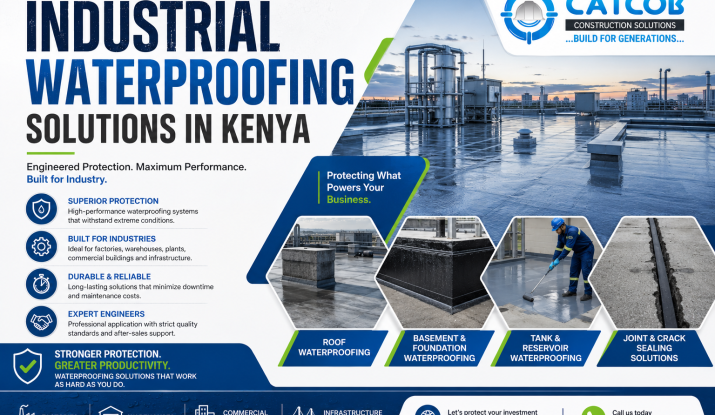
Industrial facilities — warehouses, factories, processing plants, and logistics hubs — present some of the most demanding waterproofing conditions of any building type. Vast roof areas, exposure to chemicals or industrial processes, heavy equipment loads, and the direct cost of production downtime if water damage forces an operational halt all raise the bar for what “adequate” waterproofing actually means. This guide covers the specific solutions that hold up in Kenyan industrial environments.
What Makes Industrial Waterproofing Different
Industrial buildings typically combine enormous roof surface areas with a genuine tolerance for zero downtime — a leak that damages stored goods, machinery, or halts production can cost far more than the waterproofing system itself. Industrial sites may also expose waterproofing systems to unusual stresses: chemical spills, extreme heat from certain processes, vibration from heavy machinery, and constant vehicle or forklift traffic in some areas.
Key Waterproofing Applications in Industrial Facilities
Large Warehouse and Factory Roofs
APP bituminous membranes remain the industry standard for large industrial roof areas, offering a cost-efficient, durable solution that scales well across vast, relatively uniform flat roof surfaces. Their strong heat and UV resistance make them well suited to the intense, sustained sun exposure typical of large exposed roofs.
Chemical Storage and Processing Areas
Areas exposed to chemical spills or industrial processing require waterproofing systems with specific chemical resistance — often epoxy-based coatings or specialised polyurethane formulations designed to withstand exposure to solvents, acids, or other industrial substances without degrading.
Loading Bays and Vehicle Traffic Areas
Floors and decks exposed to forklift traffic, heavy vehicle loading, and general industrial wear need a waterproofing system with strong abrasion resistance, typically a reinforced polyurethane system capable of tolerating both mechanical stress and water exposure.
Cold Storage and Refrigerated Facilities
Waterproofing in cold storage environments must account for condensation, freeze-thaw cycling, and vapour barrier requirements alongside standard water resistance — a specialised application requiring careful product selection to avoid failure under these specific thermal conditions.
Industrial Water Tanks and Reservoirs
Large-scale industrial water storage, whether for process use or fire suppression, requires robust water tank waterproofing, often at a considerably larger scale than typical residential or commercial applications.
Managing Waterproofing Projects on Active Industrial Sites
Industrial waterproofing projects frequently need to happen around ongoing operations, requiring careful coordination with facility management to schedule work during planned downtime where possible, implement appropriate safety measures around active machinery and processes, and phase large roof or floor areas to minimise disruption to production schedules. Experienced industrial waterproofing contractors understand these operational constraints and plan projects accordingly, rather than applying a standard residential or commercial project approach to a fundamentally different environment.
Preventive Maintenance for Industrial Facilities
Given the scale of most industrial roofs and the potential cost of production disruption from an undetected leak, a structured maintenance programme is particularly valuable. This typically includes regular professional inspections — often more frequent than the standard biannual schedule recommended for residential and commercial properties, given the scale and criticality involved — prompt repair of any identified issues before the next rainy season, and periodic recoating aligned with the specific system’s expected service life. Our guide on waterproofing maintenance tips to extend your roof’s lifespan provides a general framework that industrial facilities managers can adapt to their specific scale.
Choosing an Industrial Waterproofing Contractor
Industrial-scale projects demand a contractor with genuine experience managing large-scope works, appropriate safety certifications for working on active industrial sites, and the equipment and workforce capacity to complete large roof areas within reasonable timeframes. Our general guidance on choosing the right waterproofing contractor in Kenya applies here, with particular emphasis on verifying experience specifically with industrial-scale projects and confirming they can work safely around your facility’s specific operational requirements.
Cost Efficiency at Industrial Scale
While the total investment for industrial waterproofing projects is naturally larger given the scale involved, the cost per square metre for systems like APP bituminous membranes often becomes significantly more efficient across very large roof areas, since material and labour setup costs are spread across a bigger surface. See our general waterproofing pricing guide for broader context, though industrial quotations should always reflect a detailed site-specific assessment.
Frequently Asked Questions
How does industrial waterproofing differ from commercial waterproofing?
Industrial facilities often face additional stresses — chemical exposure, heavy vehicle traffic, and extreme production downtime costs — that require more specialised systems and more careful project scheduling than typical commercial buildings.
Can industrial waterproofing be done without stopping production?
In many cases yes, through careful phasing and scheduling around planned downtime, though this requires experienced contractors familiar with working on active industrial sites.
What’s the biggest risk of neglecting industrial roof maintenance?
Beyond direct water damage to stock or equipment, undetected leaks can lead to costly production downtime and, in severe cases, safety hazards from water contact with electrical systems or machinery.
Final Thoughts
Industrial waterproofing demands specialised systems, careful project management, and a genuine understanding of operational constraints on active sites. Contact Catcob Construction Solutions for an industrial waterproofing assessment tailored to your facility.
This article was researched, written, and optimised by Onyonka J.M., a Top SEO specialist and digital content strategist with expertise in the East African market; developing high-quality, search-driven editorial content that enhances online visibility and supports the growth of organisations and industry partners across Kenya and Africa. Learn more about the author.