
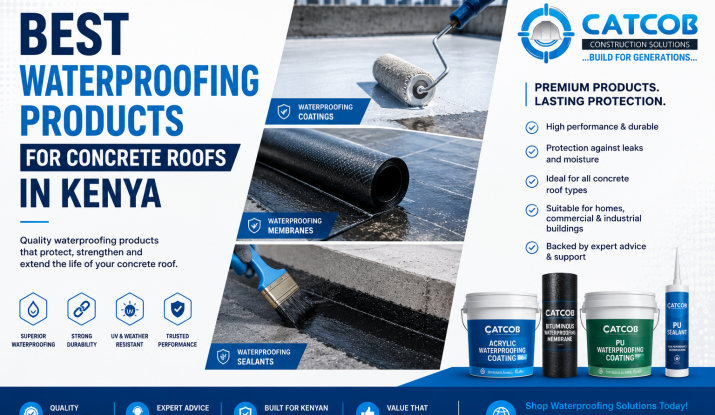
Flat concrete roofs are common across residential, commercial, and industrial buildings in Kenya, but they’re also one of the most leak-prone parts of any structure if not properly protected. With Nairobi and much of the country experiencing two rainy seasons a year, choosing the right waterproofing product for concrete roofs is one of the most important decisions a homeowner, developer, or facilities manager will make.
This guide breaks down the best waterproofing products for concrete roofs in Kenya, how they compare, and how to choose the right one for your specific roof.
Why Concrete Roofs Need Waterproofing.
Concrete is porous by nature. Left untreated, it absorbs water over time, which leads to:
- Roof leaks and interior water damage.
- Cracking from freeze-thaw-like expansion and contraction (day/night heat cycles).
- Reinforcement (rebar) corrosion, which weakens the structure.
- Mold and damp patches on ceilings.
- Reduced lifespan of the roof slab.
A quality waterproofing system creates a continuous protective barrier that keeps water out while allowing the structure to move slightly with temperature changes ; without cracking or losing adhesion.
Best Waterproofing Products for Concrete Roofs in Kenya.
1. APP Bituminous Membranes.
APP (Atactic Polypropylene) membranes are among the most widely used roof waterproofing products in Kenya, especially for flat concrete roofs on commercial and residential buildings.
Why they work well:
- Torch-applied for a fully bonded, seamless finish.
- Excellent resistance to UV exposure and heavy rainfall.
- High tensile strength and puncture resistance.
- Typically offer 10+ years of service life when properly installed.
Best for: Flat and low-slope concrete roofs, roof decks, terraces, and podiums.
2. Liquid Waterproofing Membranes.
Liquid-applied membranes are popular for their ease of application and ability to cover complex roof shapes, upstands, and roof penetrations without seams.
Why they work well:
- Seamless, monolithic coating – no joints for water to penetrate.
- Good elasticity to accommodate concrete movement.
- Available in polyurethane, acrylic, and bituminous emulsion formulations.
- Easier to apply on roofs with pipes, vents, or irregular shapes.
Best for: Roofs with multiple penetrations, parapets, and detailing-heavy areas.
3. Polyurethane (PU) Waterproofing Coatings.
Polyurethane waterproofing is regarded as one of the most durable and flexible options for concrete roofs, particularly where the roof is exposed to foot traffic or ponding water.
Why they work well:
- High elasticity – bridges hairline cracks in concrete.
- Strong UV and chemical resistance.
- Excellent adhesion to concrete substrates.
- Suitable for both new and retrofit roof waterproofing.
Best for: Roof decks, terraces, balconies, and roofs prone to standing water.
4. Acrylic Roof Coatings.
Acrylic waterproofing coatings are a cost-effective option for concrete roofs that don’t experience heavy foot traffic or ponding.
Why they work well:
- Reflective finishes help reduce roof surface temperature.
- Easy to apply and recoat.
- More affordable than PU or APP systems.
- Good for maintenance coats on existing waterproofing.
Best for: Budget-conscious projects and routine maintenance recoating.
5. Cementitious Waterproofing Coatings.
Cementitious waterproofing is a rigid, cement-based system that bonds strongly to concrete and is often used alongside other membrane systems for added protection.
Why they work well:
- Strong bond to concrete substrates.
- Good for roofs, water tanks, and below-grade structures.
- Cost-effective and easy to apply.
- Often used as a primer or base layer under other systems.
Best for: Water tanks, roof slabs, and areas requiring rigid waterproofing with less flexibility demand.
6. Waterproofing Admixtures (Integral Waterproofing).
For new construction, waterproofing admixtures can be mixed directly into the concrete during casting, reducing porosity from within the slab itself.
Why they work well:
- Waterproofs the concrete at a structural level.
- Reduces water absorption and capillary action.
- Works well combined with a surface-applied membrane for double protection.
Best for: New concrete roof slabs, water tanks, and basements.
Comparison Table: Concrete Roof Waterproofing Products.
| Product Type | Durability | Flexibility | Cost | Best Use Case |
|---|---|---|---|---|
| APP Bituminous Membrane | High (10+ yrs) | Moderate | Mid-High | Flat roofs, terraces |
| Liquid Membrane | High | High | Mid | Roofs with penetrations/details |
| Polyurethane Coating | Very High | Very High | High | Ponding water, foot traffic areas |
| Acrylic Coating | Moderate | Moderate | Low | Maintenance, budget projects |
| Cementitious Coating | High | Low | Low-Mid | Tanks, rigid substrates |
| Waterproofing Admixture | High | N/A (structural) | Low-Mid | New concrete casting |
How to Choose the Right Product for Your Roof.
- Assess roof usage – Is it walked on regularly? Does water pond after rain? High-traffic or ponding areas need polyurethane or APP systems.
- Check roof detailing – Roofs with many pipes, vents, or upstands benefit from seamless liquid membranes.
- Consider budget vs. lifespan – Acrylic coatings cost less upfront but need more frequent recoating than PU or APP systems.
- New build vs. retrofit – New roofs can combine admixtures with a surface membrane; existing roofs typically need a surface-applied system.
- Get a professional site inspection – The right product depends on the roof’s condition, slope, drainage, and exposure — not just cost per litre or per roll.
Application Best Practices.
Even the best waterproofing product will fail prematurely if poorly applied. Proper application includes:
- Thorough surface preparation – cleaning, repairing cracks, and removing loose material.
- Correct primer application before membrane or coating installation.
- Adequate curing time between coats.
- Proper detailing at joints, parapets, drains, and penetrations.
- Adherence to manufacturer-specified coverage rates and number of coats.
This is why working with certified roof waterproofing contractors in Kenya matters as much as the product itself – correct installation is what determines whether a system lasts 2 years or 15.
Frequently Asked Questions.
What is the most durable waterproofing product for concrete roofs?
Polyurethane coatings and APP bituminous membranes are generally considered the most durable options for concrete roofs in Kenya, particularly for roofs exposed to foot traffic, ponding water, or heavy UV exposure.
Is APP membrane better than liquid waterproofing?
Both are effective. APP membranes offer strong puncture and UV resistance for large flat areas, while liquid membranes are better suited to roofs with complex detailing, pipes, or irregular shapes, since they form a seamless coating.
How often should a concrete roof be re-waterproofed?
This depends on the product used and exposure conditions, but most systems require inspection every 3–5 years, with acrylic coatings typically needing more frequent recoating than PU or APP systems.
Can I waterproof a roof myself, or do I need a contractor? While some acrylic coatings are DIY-friendly for small maintenance jobs, membrane systems like APP and polyurethane require proper surface preparation, priming, and application technique – best left to experienced waterproofing contractors to ensure a lasting result.
Conclusion.
There’s no single “best” waterproofing product for every concrete roof – the right choice depends on roof usage, detailing, budget, and whether you’re waterproofing a new build or retrofitting an existing structure. APP membranes and polyurethane coatings generally offer the strongest long-term performance, while acrylic and cementitious systems suit budget-conscious or maintenance-focused projects.
Whichever product fits your roof, proper installation by experienced waterproofing contractors in Kenya is what ultimately determines how long your roof stays leak-free.