
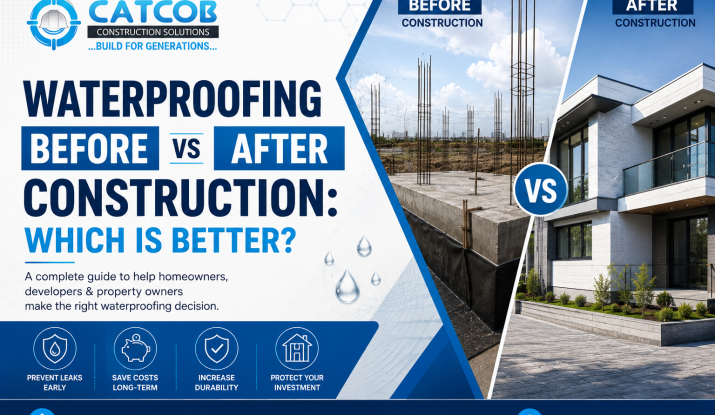
One of the most common questions property owners and developers ask is: should waterproofing happen before construction or after? The honest answer is that both approaches have a place ; but they solve different problems, cost differently, and deliver very different levels of long-term protection.
Understanding the difference between pre-construction (built-in) waterproofing and post-construction (retrofit) waterproofing can help you avoid costly mistakes, whether you’re breaking ground on a new building or trying to fix a leak in one that’s already standing.
What Is Pre-Construction Waterproofing?
Pre-construction waterproofing, also called built-in waterproofing, is applied during the construction process itself, before finishes, flooring, or cladding are installed. It’s integrated directly into the structure at key stages such as:
- Foundation and footing works.
- Basement walls and slabs.
- Roof decks, before roofing materials go on.
- Retaining walls.
- Water tanks and reservoirs, during casting.
- Bathroom and wet-area slabs, before tiling.
Common Pre-Construction Methods.
- Cementitious waterproofing coatings on foundations and basements.
- APP bituminous membrane installation on roof decks.
- Liquid-applied membranes under tiling.
- Waterproofing admixtures mixed directly into concrete.
- Crystalline waterproofing systems for below-grade structures.
What Is Post-Construction Waterproofing?
Post-construction waterproofing, often called retrofit waterproofing, is carried out after the building is complete, usually in response to a visible problem such as a leaking roof, a damp basement wall, or water seeping through a balcony.
Common Post-Construction Methods.
- Surface-applied liquid membranes over existing roofs or walls.
- Polyurethane injection into cracks and joints.
- External or internal basement tanking systems.
- Waterproof coatings applied to water tanks in service.
- Epoxy or polyurethane repair systems for concrete cracks.
- Sealant and expansion joint treatment.
Waterproofing Before vs After Construction: Key Differences.
| Factor | Before Construction | After Construction |
|---|---|---|
| Cost | Lower ; integrated into the build | Higher ; requires access, demolition, or removal of finishes |
| Durability | Longer-lasting, fully bonded to structure | Effective, but can be limited by existing damage |
| Disruption | None ; part of normal construction sequence | Can disrupt occupants, tenants, or operations |
| Access | Full access to all surfaces | Often limited to visible or reachable areas |
| Root cause treatment | Prevents problems before they start | Treats symptoms; root cause not always fully resolved |
| Warranty options | Typically longer warranties available | Warranties depend on extent of underlying damage |
| Best suited for | New builds, extensions, new water tanks | Leak repair, aging buildings, renovations |
Why Pre-Construction Waterproofing Is Usually Better.
Waterproofing applied during construction is almost always more effective and more economical than waterproofing added later, for a few practical reasons:
- Full surface access – every joint, corner, and penetration can be treated properly, without cutting into finished walls or floors.
- Better bonding – membranes and coatings bond more effectively to raw concrete than to aged, weathered, or previously coated surfaces.
- Lower long-term cost – retrofitting after a leak has caused damage often means paying for waterproofing and repair work (plaster, tiling, painting, structural repair) at the same time.
- Prevents hidden damage – moisture that enters through an unprotected foundation or roof can cause reinforcement corrosion and structural weakening long before visible symptoms appear.
This is why most experienced waterproofing contractors in Nairobi strongly recommend budgeting for waterproofing as part of the original construction cost, not as an afterthought.
When Post-Construction Waterproofing Is Necessary.
Retrofit waterproofing isn’t a lesser option – it’s often the only option, and it can still be highly effective when done correctly. It’s typically necessary when:
- A building was constructed without adequate waterproofing.
- Existing waterproofing has failed or aged beyond its service life.
- Water damage, leaks, or dampness are already visible.
- A change of use requires new wet areas (e.g., converting a room into a bathroom).
- Renovation work exposes previously hidden water damage.
In these cases, a proper site inspection and diagnosis is essential before any waterproofing work begins, treating the surface without identifying the source of water ingress often leads to repeat failures.
Cost Considerations.
As a general rule:
- Pre-construction waterproofing costs less per square metre because it’s planned, scheduled, and executed alongside other construction trades, with no need for demolition or access work.
- Post-construction waterproofing costs more, since it often includes removing tiles, plaster, or roofing materials, repairing existing damage, and re-instating finishes after the waterproofing is complete.
A professional quotation should always be based on a site assessment, since the right method – and therefore the right cost – depends on the extent and cause of water ingress, the surface condition, and the area involved.
Which Approach Should You Choose?
- Building something new? Waterproof during construction. It’s cheaper, more durable, and avoids future disruption.
- Already seeing leaks, damp patches, or water stains? You need post-construction (retrofit) waterproofing – the sooner it’s addressed, the less structural damage accumulates.
- Renovating or changing the use of a space? Treat it like new construction – waterproof before finishes go back in.
Either way, the work should be carried out by a certified waterproofing contractor who conducts a proper site inspection, recommends a system suited to the specific problem, and offers a warranty on workmanship and materials.
Frequently Asked Questions.
Is it cheaper to waterproof before or after construction?
Waterproofing before construction is almost always cheaper overall, since it avoids the demolition, access work, and finish repairs that post-construction waterproofing typically requires.
Can you waterproof a building after it’s already built?
Yes. Post-construction (retrofit) waterproofing is common and effective, provided the contractor first identifies the source of water ingress rather than only treating visible symptoms.
How do I know if my building needs waterproofing now?
Warning signs include damp or discolored walls, peeling paint, musty odors, visible mold, water stains on ceilings, or pooling water on roofs and balconies after rain.
Does waterproofing during construction add much time to the project?
Not significantly. Most pre-construction waterproofing methods are scheduled alongside normal construction stages and add minimal time compared to the cost and disruption of a later retrofit.
Conclusion.
Both pre-construction and post-construction waterproofing have their place, but prevention consistently outperforms repair — in cost, durability, and long-term peace of mind. If you’re building new, integrate waterproofing into your construction budget from day one. If you’re already dealing with leaks or dampness, don’t delay: the longer water is left untreated, the more expensive the repair becomes.
Working with an experienced waterproofing contractor in Kenya, one that offers both new-build waterproofing and retrofit solutions — ensures your property is protected correctly, whichever stage you’re starting from.